Residency Scheduling Software: A 2026 Buyer’s Guide
Elizabeth Wong, MD
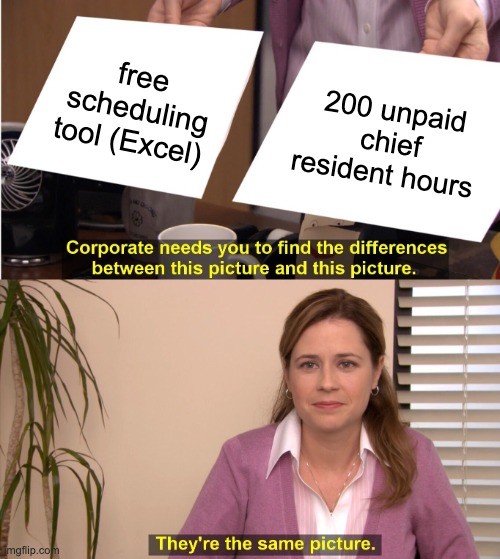
Most chiefs start their software search the same way: they Google or ChatGPT "residency scheduling software," open a handful of tabs, and quickly realize that most of what comes up wasn't built for residency programs at all and don’t trust them.
That's the first thing worth knowing. The healthcare workforce management software market is large, but the slice of it designed specifically for graduate medical education — block schedules, ACGME duty hours, rotation equity, night float, the full 52-week training year — is much smaller than the search results suggest.
This is an honest breakdown of what's actually out there.
First: residency scheduling is not shift scheduling
Before evaluating any tool, it helps to be clear about what you're actually trying to solve.
General staff scheduling is a shift-fill problem. You’re trying to solve Coverage.
Residency scheduling is something else entirely. You're distributing residents across rotations for an entire academic year — while satisfying ACGME duty hour limits, maintaining educational continuity, tracking night float equity, honoring golden weekend policies, accommodating board leave, and following a set of program-specific rules that often exist only in the outgoing chief's head.
It's less a calendar problem and more a constraint optimization problem — and most general scheduling tools aren't built for it.
What's out there in 2026
Here's an honest look at the main options.
Tool | Built for residency? | ACGME-aware? | Automation | Best for |
|---|---|---|---|---|
Amion | Yes | Partial | Low | “Am I On?” problem; clinic scheduling |
MedRez | Yes | Partial | Low–Medium | Programs wanting manual control in a dedicated tool |
QGenda | Yes | Partial | Medium | Health system rollouts; integrates with New Innovations |
Standard Form | Yes | Yes | High | Residency block scheduling + ongoing AI-assisted management |
Excel | No | No | None | The default for most programs, it’s free! |
Outsource Agency | Varies | Varies | N/A | Programs that want to hand scheduling off entirely |
Amion
Amion has been the incumbent for decades, and a lot of programs use it simply because they always have. It's genuinely good at call scheduling and gives programs a shared place to view and distribute the schedule.
What it doesn't do: generate a schedule. Chiefs still build it manually — Amion is the interface for sharing the result. For programs with complex block scheduling needs, that's a meaningful gap.
MedRez
MedRez is purpose-built for residency and fellowship programs, which already puts it ahead of most general scheduling tools. It handles block scheduling, call, and rotation management, and has been adopted by a range of GME programs over the years.
Like Amion, it's primarily a manual tool — the chief or administrator builds within the system rather than having the system generate a schedule. For programs that want residency-specific structure without full automation, it's a reasonable choice.
QGenda
QGenda is the dominant platform for large hospital systems. It has a residency module and integrates with New Innovations, which makes it a natural fit for health systems already embedded in that ecosystem.
For standalone residency programs evaluating it independently, the calculus is harder. Implementation takes months, the cost is significant, and the product wasn't designed from the ground up for GME. It's worth including in your evaluation if your institution is already a QGenda shop — less so if you're starting from scratch.
Excel
Excel is still the most common scheduling tool in residency. It costs nothing, requires no onboarding, and everyone already knows how to use it.
The problems are well-documented: no built-in compliance checking, no equity tracking, no change propagation, and no institutional memory when the chief turns over. Most programs don't move off Excel until a schedule breaks badly enough to force the conversation. If you're reading this, you're probably getting close to that point.
Outsource Agency
Some programs hire external scheduling consultants or agencies — often former chief residents or GME administrators — to build and manage the schedule on their behalf. This works for smaller programs without the bandwidth to own it internally, or during rocky transitions between chiefs.
The tradeoff is cost, reduced institutional ownership, and dependency on an external party every time something changes mid-year.
Five questions worth asking before you commit
Sales demos are designed to show software at its best. These questions are designed to find the edges.
1. Block scheduling or shift scheduling?
These are different problems. Confirm which one the tool was actually built to solve.
2. How does ACGME compliance actually work?
Does the system flag violations automatically — 80-hour limits, 24+4 rules, minimum rest — or does that still fall on you to audit manually after the schedule is built?
3. What does setup realistically look like?
Ask for a real timeline from contract to working schedule. Some tools require months of rule configuration before they produce anything useful. That's a real cost.
4. How does it handle mid-year changes?
Swaps, leave, cohort adjustments — they happen constantly. Ask how a change in one rotation propagates through the rest of the schedule. If the answer is "you rebuild manually," that matters.
5. What happens at the chief handoff?
Chiefs rotate every year. Does the scheduling knowledge transfer with them, or does it live in whoever set the system up?
Where Standard Form fits
Full disclosure: I'm the co-founder of Standard Form, so this is my conflict of interest statement.
Standard Form is an AI-native scheduling platform built specifically for residency programs. Chiefs define their scheduling rules in plain English — the system converts those into constraint-based logic, generates a compliant schedule, and helps manage it throughout the year with AI assistance.
That last part is the piece most tools miss. Generating the initial schedule is one problem. Managing it through 52 weeks of swaps, leave requests, and last-minute changes is another. Standard Form is designed to handle both.
We're earlier-stage than Amion or QGenda. Smaller implementation track record. But if you're evaluating software that was actually built for the block scheduling problem — and that doesn't require you to rebuild from scratch every time something changes — it's worth a look.
Book a 20-minute demo if you want to see how it works.
Evaluating scheduling software for your program?
Book a Demo — we'll walk you through how Standard Form handles your program's specific rules and constraints.
Thanks to Owen Kosman for reading drafts of this.
Tips for chiefs and program directors
Sign up and get our tips regularly